

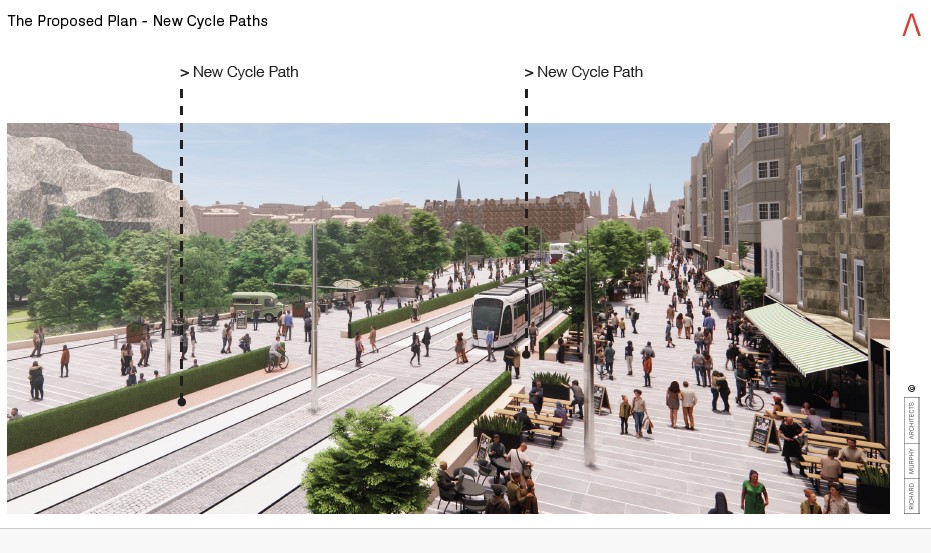
A major council workshop of some 100 councillors, officers, experts and community representatives (including Spokes) to discuss the future of Princes Street and the Waverley Valley was held on 8 June. Specifically on Princes Street, the discussion boiled down to two alternatives: the officers’ preferred “Ambitious Pragmatism” solution which comprises footway repaving and some other enhancements (as below); or “Complete Rethink” which means rethinking the roadspace, to give much improved pedestrian space and segregated bike lanes.
Paul Lawrence, the Council’s Chief Executive, stated that officers will now consider all points raised at the workshop and prepare a set of options for councillors to take decisions in September.
Important note: this short article about the workshop is an update to our article of 25 February. Please do read that article for all the background, and how the Council has arrived at the current position, thanks to unusually and unexpectedly bold decisions by councillors. It also explains why, in the absolutely unique situation of a bus/tram-only Princes Street, with maximum pedestrian provision, large numbers of walkers, and street width at a premium, Spokes could agree bike lanes passing on the carriageway side of bus stops (rather than floating bus stops).
The Princes Street alternatives on offer at the workshop were…

The Ambitious Pragmatism content and rationale were laid out in an overall presentation and a more specific briefing on transport aspects. As can be seen from the above slide, the Princes Street element of this basically comprises repaving footways, some widening to the south footway, improved seating and garden accesses.
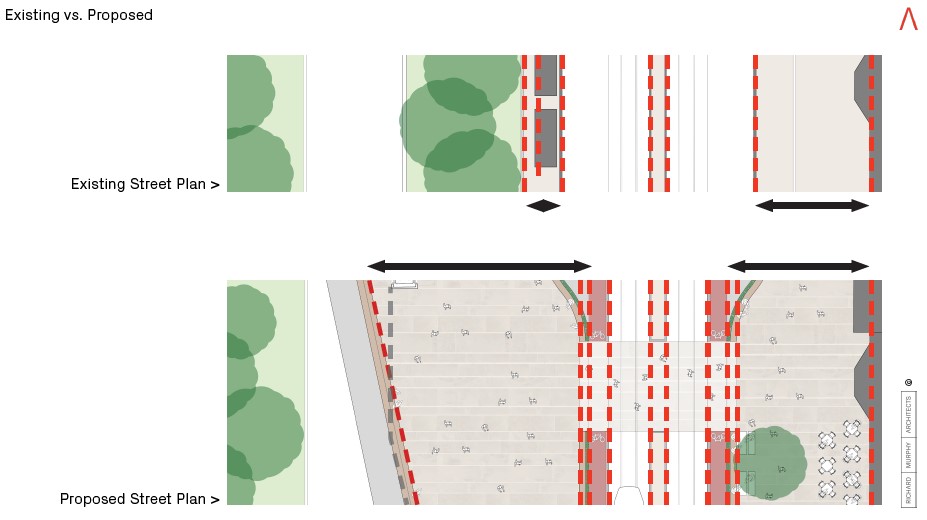
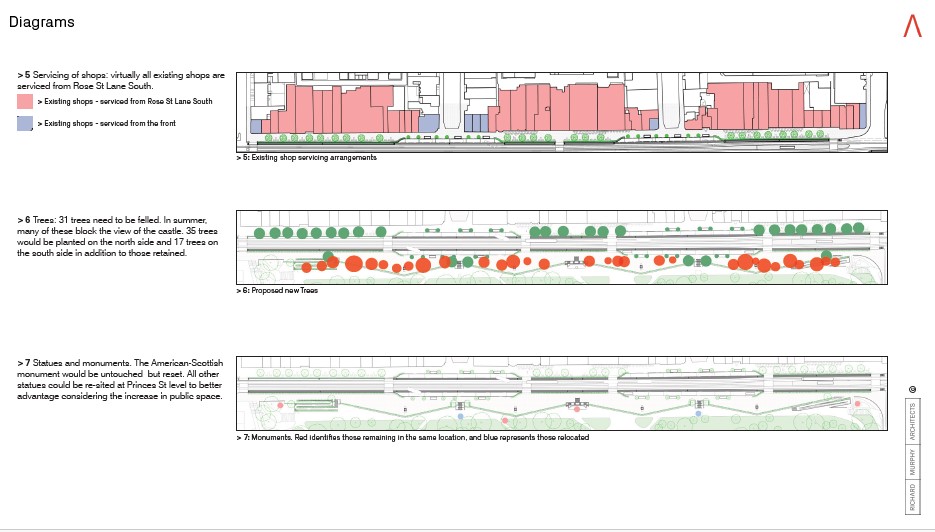
The Complete Rethink was exemplified by a presentation from Richard Murphy, expanding on his earlier material as in our 25 Feb article. Since his presentation is 36MB, and includes a lot on Princes Street gardens, we have not uploaded it, but have extracted relevant slides around Princes Street itself.

Spokes input
Although the only presentations at the workshop were by officers and professionals, points made by Spokes during discussions included…
- Whilst George Street is important for many bike journeys, for many others there is no sensible alternative to Princes Street. For example, to use George Street when travelling from Waverley station/ Waverley Bridge to the West End would entail turning right off Princes Street whilst crossing tramlines [see section 1 of our February article]
- We believe that cycling is at least as prevalent on Princes Street as on George Street, and is likely to grow with the increasing use of the Voi bikes in the city centre. The Council has not published any figures on this, but Spokes hopes to organise a count after the Festival
- The dangers of bike/tramline crashes on Princes Street are real, not imagined, and we are not convinced that this, and the resulting injuries, are being taken seriously enough. For example, this is not mentioned in the above transport-issues paper. Yet, see this BBC Scotland report detailing crashes, injuries, the death of Zhi Min Soh, and compensation paid by the Council following early successful court cases brought by victims. Here is a more recent example, from January 2026. Fortunately, the rate of crashes has declined since the early years, as the Council has tackled known blackspots. However, analysis of tramline crashes reported to Spokes suggests, perhaps unexpectedly, that roughly 50% occur not at crossing-point blackspots, but at random locations when the cyclist is travelling in the same direction as the tramlines, not needing to cross them, but is forced into them by traffic, or encounters them for other reasons. The only realistic safety solution is physical separation* from the tramlines.
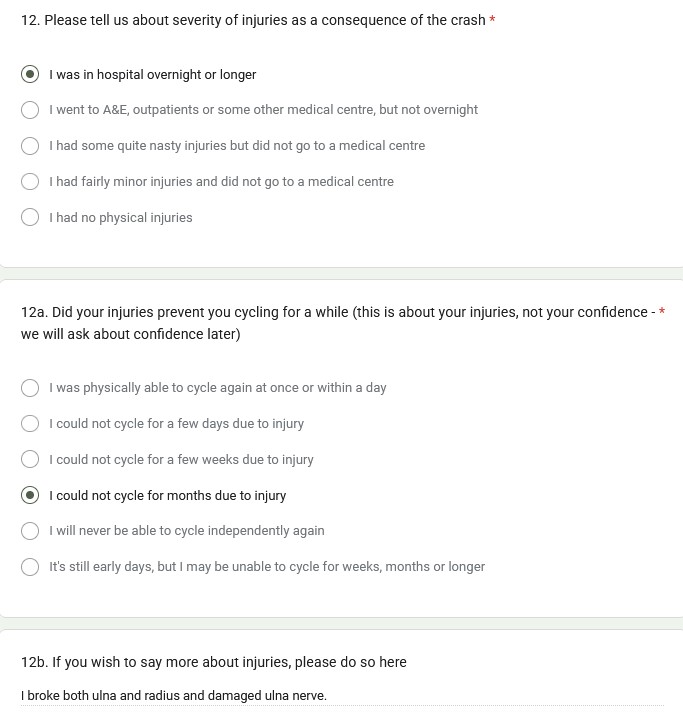
*There is an instructive comparison with Leith Walk, where segregated bike lanes were introduced as part of the tram project. There has been justified criticism over some aspects of these lanes, but the safety record is excellent. Firstly, in the roughly 4 years so far, we have only heard of one bike tramline crash – when the cyclist left the bike path and joined the carriageway (which was then empty), in advance of her planned junction turn. The position for pedestrian safety, however, is particularly remarkable – and hugely welcome. Despite predictions of increased pedestrian casualties as a result of the bike lanes, police stats show that Leith Walk pedestrian casualties have in fact fallen astonishingly [credit to Ed Tissiman for identifying this]. The reasons for this are not known but, given that virtually all pedestrian injuries result from motor vehicles, we speculate that crucial factors are the separation of pedestrians from the carriageway by the cycle lanes, and safer road crossings due to the ban on kerbside parking.
Bus Issues
One of the main issues of contention at the workshop was ensuring a highly quality bus service remains, which Spokes strongly supports.
The Council document references 2024 modelling which suggested a drastic impact on bus services from a stretch of narrowed roadway – however this modelling has not been made public and, according to the document, assumed removal of half the bus stops.
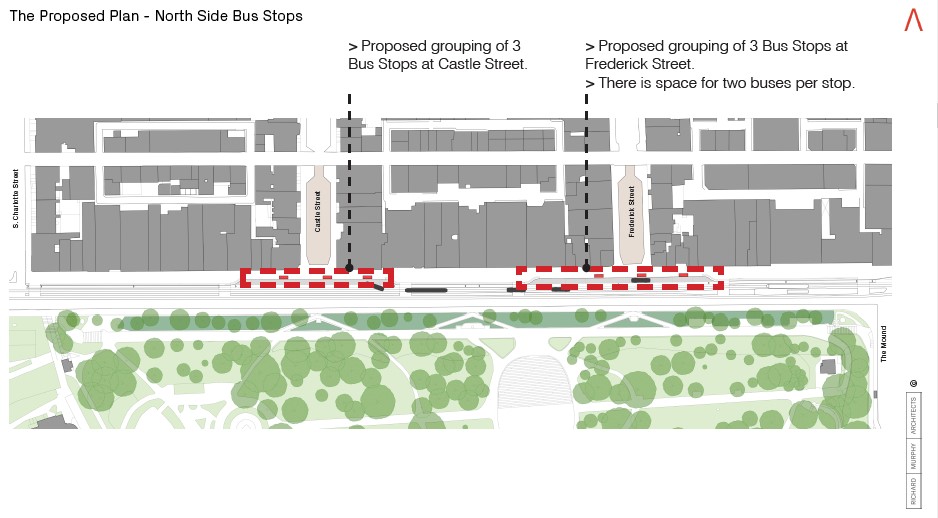
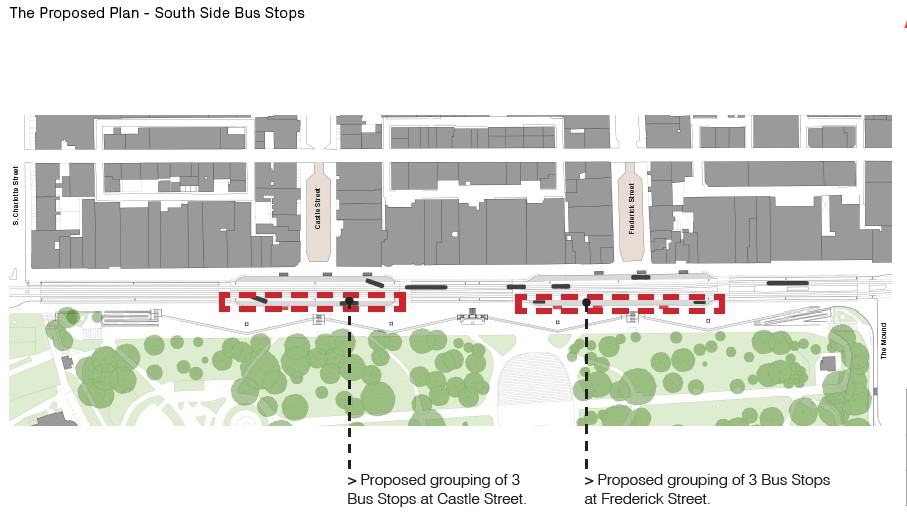
Richard Murphy claims that his proposals would cater for all the existing buses which stop in Princes Street, with spaces for up to 9 buses stopped at the same time in either direction, in this western half of Princes Street [see pictures below]. Non-stopping buses/coaches would be asked to use another route [there is some dispute over whether the Council has powers to do this, but in any case it is expected that the Scottish Government will devolve any further such powers if necessary].
Other relevant Richard Murphy slides
What you can do
- Tell your councillors your views on what should happen to Princes Street
- Repost our bluesky of this article
- Like our facebook post