

E-bikes have transformed cycling opportunities in recent years. Cycling becomes more realistic and attractive for anyone who finds riding a push bike difficult. Cargo bikes carrying children or heavy/bulky loads are also far easier to use if they have a battery and motor, and this has enabled these cycling purposes to flourish.
More recently, publicity about battery fires and about illegal use of modified e-bikes has led, in the media and elsewhere, to a misleading and unfortunate widespread use of the term ‘e-bike’ to include such machines.
Now, the bicycle industry trade body, the Bicycle Association, has launched the E-Bike Positive campaign, which lists brands and retailers which provide only safe and legally-compliant e-bikes. There is also new guidance from the Bicycle Association and the Motorcycle Industry Association to enable the police and others to understand very clearly which category any given ‘bike’ falls into. And Fabian Hamilton MP is pressing the BBC and other media to understand and reflect the true position.
Battery Safety
Concerns about fires caused by lithium batteries have led to worries about safety, and restrictions by some landlords, employers and others (e.g. Waverley Station) on e-bike storage.
In reality the problem lies with sub-standard batteries, or batteries which have been modified or damaged. E-bike batteries sold with CE and UKCA safety certification include Battery Management Systems – equivalent to a household fuse box which prevents overheating, using safety cut offs.
Legal Compliance
In genuine e-bikes, battery assistance only kicks in when pedalling, and not above 25kph speed. Unfortunately unscrupulous providers are selling, as e-bikes, modified machines which in reality fall into the moped/motorbike category and so can only legally be used on roads if taxed, with helmets, etc. But, exploitative contracts by some delivery companies have resulted in considerable illegal use of such machines, to the detriment of pedestrians and cyclists.
E-Bike Positive Trust Mark

The new E-Bike Positive Trust Mark is awarded to e-bike brands that have been audited by the Bicycle Association as safety-tested as well as fully UK road-legal.
It also specifies retailers and mechanics who sign up as E-Bike Positive and have committed to the following best practice:
- To sell only road legal e-bikes which are safety-tested and from trusted suppliers, and which come with full safety information and user instructions.
- To repair only road legal e-bikes.
- To repair or modify e-bikes only in accordance with the manufacturer’s instructions.
- To ensure that after any repair or modification, the e-bike can be charged and used safely. If this cannot be guaranteed, to refuse to do the work.
- To supply only safety-tested chargers and batteries from trusted suppliers.
- To supply only chargers, batteries and other components which are documented to be compatible with each other, and with the e-bike where they will be used.
- To supply chargers and/or batteries with full safety information and user instructions.
E-bike Legal Compliance Guide
New guidance from the Bicycle Association and the Motorcycle Industry Association uses a series of flow charts to clarify whether an electrically-assisted pedal machine is to be treated as a bicycle or a moped or motorbike.
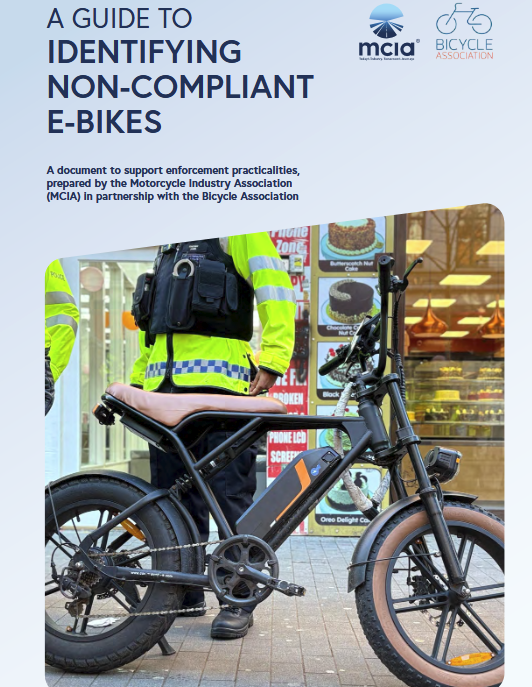
The guide lists the three key requirements laid down in official EAPC guidance:
- propulsion by pedals
- having an electric motor rated as less than or equal to 250W continuous power
- motor assistance cutting out at a speed of more than 15.5 mph.
Note that e-bikes are also allowed to have walk-assist propulsion not requiring pedalling only up to 3.7 mph, to help with hill starts
Any vehicle which doesn’t meet these requirements is treated as a motor vehicle and the rider requires a licence, insurance and to wear a motorcycle helmet.
While the new guidance is welcome, enforcement is currently limited both through police staffing constraints and the difficulty of stopping offending cyclists safely.
Companies such as Deliveroo and Uber Eats should be forced to ensure that their delivery riders are using compliant e-bikes and are being paid fair wages. In New York three delivery apps accused of “cheating workers” are being forced to repay $4.6 million in wages that it held back from deliveristas in violation of the city’s landmark minimum pay law.
Dr Scott Arthur, MP for Edinburgh South West, and a Spokes member, has asked the Scottish Government to give Police Scotland “the powers and resources they need to properly tackle this issue.” And, at Westminster, he is pushing the UK Government to go further in restricting the import and sale of illegal e-bikes, e-scooters, and modification kits. He told the Edinburgh Reporter …
“Quite frankly, it’s outrageous that shops are allowed to sell these devices knowing full well that, outside of private land, there is no legal place to use them in Edinburgh. We need action, and we need it now.”
Fabian Hamilton MP, BBC initiative
Labour MP for North East Leeds Fabian Hamilton has, with the support of the Bicycle Association, has now urged the BBC Director of Editorial Policy and Standards to finally direct editorial teams on the damage that conflation of EAPC e-bikes and other modified, or non road legal electric motorbikes can cause.
Europe & Wider
Similar issues are seen across Europe. This paper from European Cycling Industries discusses the issues and possible steps forward.
And this video covers this issue from a US perspective.
Spokes Info
- We have updated our E-bike info page and factsheet to include much of the information in this article
- See also page 11 of our 2026 Spokes Bulletin (#140) – print copies available
- Please repost our bluesky of this article.