

The Scottish Government’s latest annual Programme for Government policy document (PfG, September 2026) has only one mention of active travel – a graphic which is one of the most misleading we have encountered for a long time
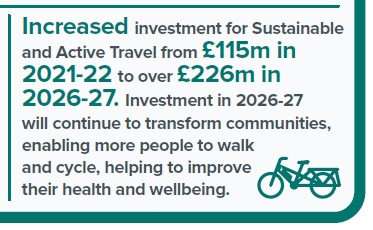
Anyone looking at the PfG graphic would come away believing that Scottish Government investment in active travel was on a major rising trajectory – and particularly cycling, given the bike logo. In fact, funding budgeted purely for active travel has been on a declining trend since the 24/25 financial year.
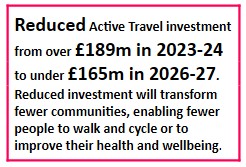
Ministers gaily quote the figures in the (green) PfG graphic, possibly not even aware that the presentation hides the very different reality shown in our own (red) interpretation above.
The true picture for active travel, as far as we can assess it, was laid out in the table below, in this article following the 26/27 budget announcement. See that article for more background to the table.
| Budgets (£100k) | 21/22 | 22/23 | 23/24 | 24/25 | 25/26 | 26/27 |
| Total transport | 3306.0 | 3485.4 | 3578.6 | 3925.4 | 3906.9 | 4145.3 |
| Total AT estimate | 115.5 | 150.0 | 189.2 | *219.9 | 166.1 | **163.4 (?) |
| AT as % | 3.5% | 4.3% | 5.3% | *5.6% | 4.3% | **3.9% (?) |
Note: the table above shows the budgeted figures but in some years AT funding was cut during the year and so actual investment never reached the totals or %’s shown in this table. *In the worst case, 24/25, the £220m originally budgeted was cut to £155m during the financial year, meaning that actual AT investment was only around 4% of total transport rather than the originally budgeted 5.6%. **In the current financial year, a cut of £4.7m has already been announced [see below] reducing our estimated 3.9% to 3.8% unless balanced by a rise elsewhere in the budget.
Why so misleading? … we explain
There are two main reasons why the PfG graphic is so misleading…
- Not comparing like with like. Until 24/25 the Active Travel budget line covered exactly that – active travel. Funding towards bus infrastructure came from a different heading. But in 25/26 the budget line was renamed “Active and Sustainable” (incidentally, the PfG graphic renames it “Sustainable and Active“). It transpired that the Bus Infrastructure Fund, now taken from this budget line, would comprise £20m in 25/26 and £60m in 26/27. As we made clear at the time Spokes strongly supports bus infrastructure funding, but lumping it in with active travel provides a handy way to obfuscate what is happening to active travel money. So, the £226m for 26/27 in the PfG graphic represents at best £166m for active travel (and there are probably a few other minor deductions)
- Selective choice of dates. In comparing the 26/27 figure with 21/22, and not showing the intermediate figures the government is carefully choosing which year to use. Certainly, active travel budgeted expenditure rose substantially between 21/22 and 24/25, thanks to the November 2021 SNP/Green joint Shared Policy Programme (the ‘Bute House’ agreement) which included the superb promise that “by 2024-25 at least £320m or 10% of the total transport budget will be allocated to active travel.” The commitment then appeared in multiple government documents (example) but since the government scrapped the agreement in 2024, active travel funding has been on a gradual decline. A fairer comparison in the graphic would surely be with the position when the policy changed, or at least to show all the dates. Furthermore, going by the reduced active travel priority apparent in the SNP 2026 election manifesto, where an active travel budget is not even mentioned, a continuation of this downward trend seems worryingly possible.
Reduced funding for People and Place
The active travel budget line includes a ‘People and Place‘ fund for councils and Regional Transport Partnerships, for schemes to encourage behaviour-change. In May 2026 the revenue funding element of this fund was cut by 60%, from £7.9 million to £3.2m, as part of wider government cuts (the capital element of People and Place fortunately remained unchanged at £15.5m).
The cut particularly affects many community groups who run projects to encourage cycling, often amongst children, novices and people with disabilities, and it resulted in a powerful letter to the Cabinet Secretary for Transport, Stephen Flynn, signed by around 70 concerned Scottish organisations, including Spokes.
Clearly, taken alongside the reduced active travel priority in the SNP 2026 manifesto, as compared to their previous (2021) manifesto, there is concern that other portions of the active travel budget will also be cut – or perhaps, less transparently, just left unallocated – before the end of the financial year.
Trunk Road Dualling
It is also concerning that, although this 80-page PfG is the longest for some years, it for the first time does not mention cycling or active travel anywhere in the text, apart from the above highly misleading graphic.
In contrast is a continued strong commitment to trunk road dualling, notably the A9 and A96. This widening will increase traffic not just on the expanded roads, but, in consequence, in connecting rural roads, towns and cities. Electrifying and/or dualling the adjacent single-track main-line railway could, alternatively, take lorries and cars off these roads and provide a superb connection to the Highlands for work, leisure and the important visitor economy – but is not even mentioned.
In terms of cost-benefit, it is our understanding that A9 dualling originally failed the cost-benefit test, which in consequence was modified to include a never-before used factor of ‘driver frustration’ and thus a slightly better, though still only just over 1:1, cost-benefit (see Scottish Parliament SPICe analysis). Indeed, a more recent A9 business case states.. “The A9 Dualling Programme demonstrates a BCR [Benefit-Cost Ratio] of 0.52 that rises to 0.81, when including Driver Frustration and Wider Economic Impacts, which equates to Low Value for Money.”
Given the rapidly growing climate crisis, it is important also to consider the carbon impacts of different choices about where government transport funding should go.
The government is required to produce a carbon assessment showing the impact of funding decisions on its climate targets.
In the 26/27 budget’s detailed tables, bus and active travel investment (combined funding increase £37m) are classed as ‘Low positive‘ for climate. In contrast, trunk roads spending (£90m increase) is classed as ‘High negative.’ The tables explain that the capital element of trunk roads money “Provides for design, development and delivery of trunk road schemes, including the upgrade to dual carriageway of the A9 between Perth and Inverness, improvements to the A83 at the Rest and Be Thankful, and funding for progress with other schemes in the Trunk Road Network Programme, including A96 Dualling” and the reason for the £90m increase is “largely to account for more sections of the A9 dualling programme entering delivery stage.”
Trunk road expansion is discussed in more detail by Transform Scotland in ‘Roads to Ruin – 5 years on‘ and the original ‘Roads to Ruin‘.
What you can do
- The draft Scottish budget for next financial year, 27/28, is currently due to be announced in the Scottish Parliament on 3 December.
- Please consider emailing your MSPs, of all parties, asking them to ensure that funding for active travel rises in the budget* and explaining why this matters to you.
- For SNP MSPs, ask them to pass your concerns to the Ministers responsible for the budget and for Transport, and to let you know the outcome
- For MSPs from other parties, ask them to ensure that their own shadow budgets include an increased allocation to active travel, and to let you know what it will say
- If you wish, also ask your MSPs that bus infrastructure funding should have its own budget line rather than being conflated with active travel, so that increases in one cannot be used by Ministers to disguise cuts in the other, as happens at present
- Send us a copy of your email and any useful replies
- Repost our Bluesky.
* Spokes, along with many other bodies, including public health organisations, argues that 10% of the transport budget should be allocated to active travel, as Edinburgh Council already does. Indeed, this was also Scottish Government policy from 2021 until scrapped in 2024, as explained above.